Companies across the chemical, plastics, textile, food, and cosmetics industries are under increasing pressure to make their production more sustainable, replace fossil-based feedstocks, and remain competitive. Industrial biotechnology offers a promising path forward. Microorganisms such as yeast can convert renewable carbon sources and residual biomass into high-value products, including platform chemicals, proteins, dyes, and pigments for industrial applications.
Despite this potential, many promising technologies fail to reach industrial implementation due to two major hurdles. “Developing customized host strains is both time-consuming and costly,” says Professor Ruben R. Rosencrantz, Head of the Life Science and Bioprocesses Research Division at Fraunhofer IAP. “At the same time, many organizations lack the expertise needed to translate biological performance into robust, scalable, and economically viable manufacturing processes. Our collaboration addresses this exact gap.”
The collaboration combines strain engineering and bioprocess development
The special feature of the collaboration lies in the close integration of synthetic biology, strain engineering, and bioprocess design. While the TAILOR junior research group develops new tools for the targeted adaptation of yeast, Fraunhofer IAP contributes its infrastructure and expertise in the design, optimization, and scaling of industrial bioprocesses.
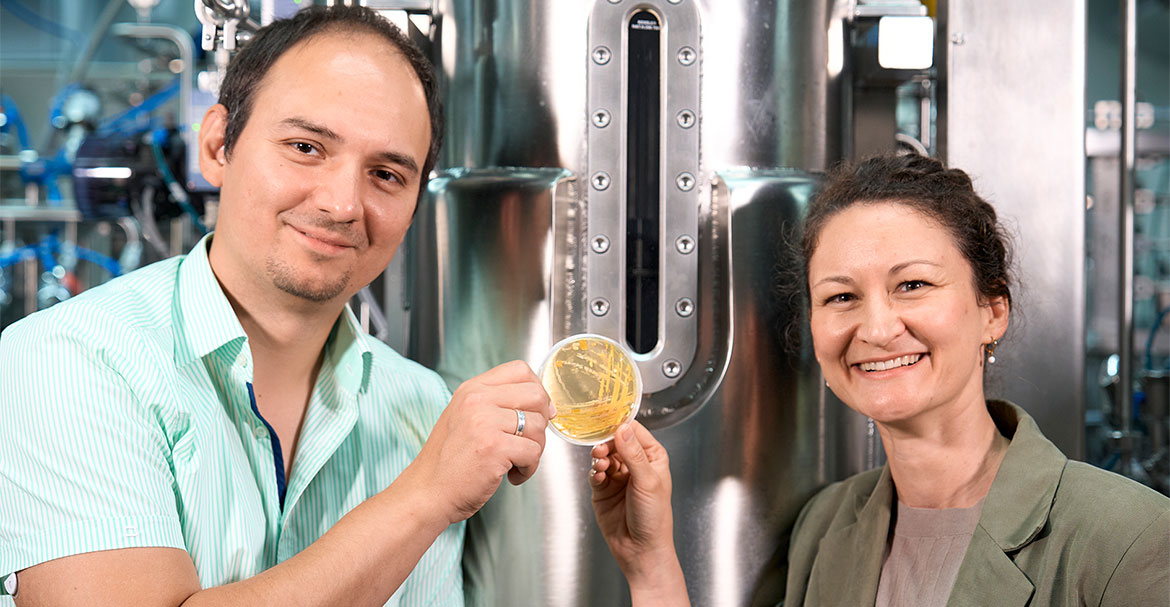
“An integrated approach that combines strain engineering and bioprocess development from the very beginning is rare,” says Dr. Lena Hochrein, Head of the TAILOR junior research group at the University of Potsdam, describing the collaboration’s significance.
For companies, this means access to an integrated approach: From selecting suitable host organisms and designing genetic control modules to process optimization in the bioreactor and the production of sufficient quantities of material for downstream application testing—all from a single source.
Yeast are strains specifically developed for industrial applications
The TAILOR team develops synthetic biology tools that enable yeast strains to be precisely engineered for specific industrial applications.
“We design genetic control modules that direct yeast cells to produce specific molecules at defined levels,” Hochrein explains. “These products range from proteins for food and cosmetic applications to a broad spectrum of biobased chemicals.”
A particular focus is on nonconventional yeast species capable of utilizing sustainable feedstocks or industrial by-products. These organisms also expand access to new classes of biobased products and broaden the portfolio of microbial production platforms suitable for future industrial bioprocesses.
How a promising yeast strain becomes a scalable production process
Engineering high-performing yeast strains is only one step toward industrial implementation. Production processes must also ensure stable growth in bioreactors, high cell densities, and commercially relevant product yields.
Fraunhofer IAP's Life Science and Bioprocesses Research Division provides expertise in fermentation, process development, downstream processing, and process scale-up to the 100-liter scale.
While research at the University of Potsdam has primarily been conducted at the laboratory scale, the collaboration now enables critical scale-up questions to be addressed. How does a strain perform in a bioreactor? Which process parameters influence growth and productivity? How can strain engineering and process design be optimized together to establish an economically viable manufacturing process?
Supporting companies across multiple industries
The collaboration is aimed at companies and development partners that want to tap into new biobased building blocks for their production, convert existing microbiological processes to alternative feedstocks, or develop new process routes based on residual materials.
These services are also relevant to companies that need support with fermentation, process optimization, scaling, or the production of larger product quantities for material and application testing.
Residual materials can become starting points for new value creation
The researchers see significant potential in using residual biomass from agricultural and forestry processes. For example, industry partners can start a project with yeast strains that already grow on previously unused waste streams. Together, the partners investigate which products can be produced with these organisms and how their metabolic processes can be specifically regulated so that the desired molecule is produced in high yields.
Yeast strains can also be specifically adapted to residual materials, such as by-products of sugar production or other secondary and tertiary feedstock streams. The goal is to unlock new value creation potential, broaden the feedstock base, and strengthen regional material cycles.
In the long term, the approach offers a path toward supplying entire value chains solely from residual materials and biomass: from chemicals and materials to food, home and personal care, and energy carriers. In this way, companies can gradually become independent of fossil feedstocks.
Advancing the bioeconomy in Brandenburg
“This approach is particularly relevant for Brandenburg's economy,” Rosencrantz says. “The bioeconomy is one of the state's strategic innovation priorities.”
“Due to the region’s strong agricultural structure, raw materials and residual streams are generated that could serve as a starting point for biotechnological processes. Combining strain engineering and process design can help translate this potential more effectively into industrial value creation,” Rosencrantz says.
Through their collaboration, the University of Potsdam and Fraunhofer IAP are bridging the gap between university research and industrial implementation. The goal is to move biotechnological innovations into practical application more quickly and support companies in building sustainable, circular value chains.
Links:
https://www.uni-potsdam.de/en/ibb-syntheticbiology/research/tailor-project
https://www.iap.fraunhofer.de/de/Forschungsbereiche/Life_Science_und_Bioprozesse.html