
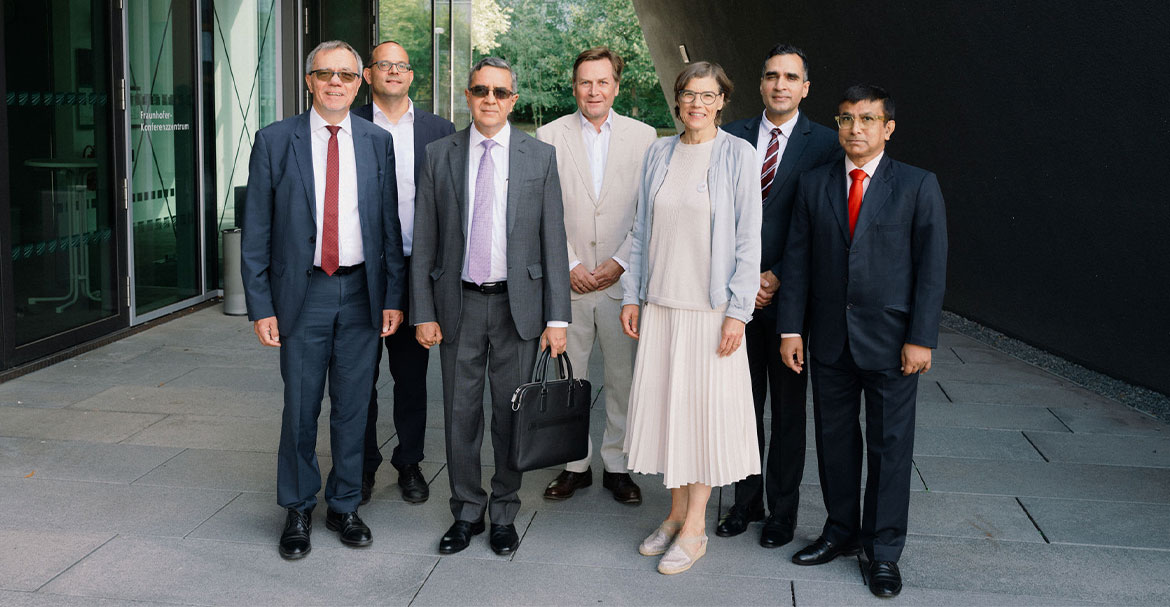
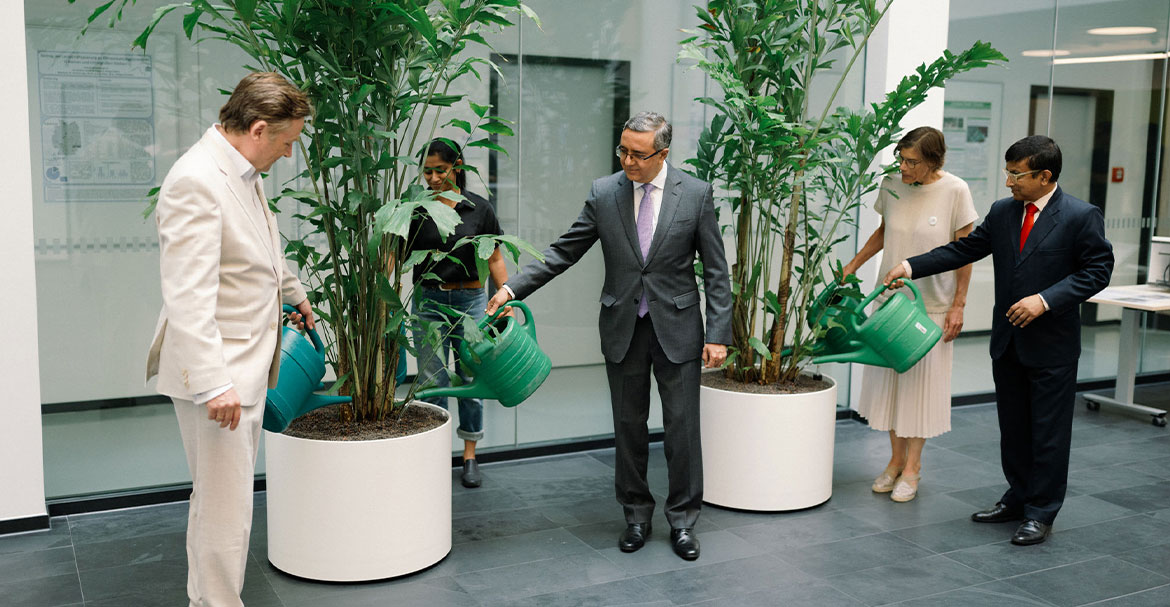
Following a welcome and presentation of the new research and teaching building for the environmental sciences, which opened in March, Prof. Dr. Ralph Gräf, Dean of the Faculty of Science, and geologist Prof. Dr. Stefan Norra highlighted the importance of scientific cooperation with India. The participants discussed numerous ideas for strengthening this cooperation further. Prof. Norra proposed establishing a central coordination office to help give joint projects involving the two countries further momentum. Andreas Kubatzky, coordinator of the international master’s degree program Climate, Earth, Water, Sustainability (CLEWS), called for more opportunities to meet, exchange ideas, and participate in workshops in order to bring researchers and students from both countries into closer contact. The visit concluded with a direct exchange between the ambassador and Indian doctoral candidates and University of Potsdam researchers.
With nearly 3,000 students, Indians make up the largest group of international students at Brandenburg’s universities. In January 2026, the State of Brandenburg and the Indian state of Uttarakhand signed a Joint Declaration of Intent aimed at establishing long-term cooperation in disaster preparedness and early warning systems, data science and artificial intelligence, digital technologies, clean energy and the hydrogen economy, as well as new materials and innovative manufacturing. The State of Brandenburg maintains ties with numerous Indian academic and research institutions through the University of Potsdam, Brandenburg University of Technology Cottbus-Senftenberg, the Potsdam Institute for Climate Impact Research, and the GFZ Helmholtz Centre for Geosciences. Key areas of cooperation include geology, hydrology, computer science, new materials, and clean energy.
More information: https://mwfk.brandenburg.de/mwfk/de/service/pressemitteilungen/ansicht/~11-08-2026-indischer-botschafter-besucht-potsdamer-wissenschaftseinrichtungen#