
The building used as a shared apartment was rather unusual, even in times of acute housing shortages: a garage belonging to the former state parliament on Brauhausberg, the hill overlooking Potsdam where the Localize Festival took place in the summer of 2026. Since 2008, the festival’s volunteer organizers have regularly transformed selected locations in Potsdam into temporary spaces for art, culture, and music. Previous editions have been held on Freundschaftsinsel, in the city hall, and in the area around Lake Arado, among other places – each time raising questions about the use of public space. In 2026, in what is likely to be its final edition, Localize chose the very site where the University of Potsdam’s fourth campus will be built.
Displaying and Testifying
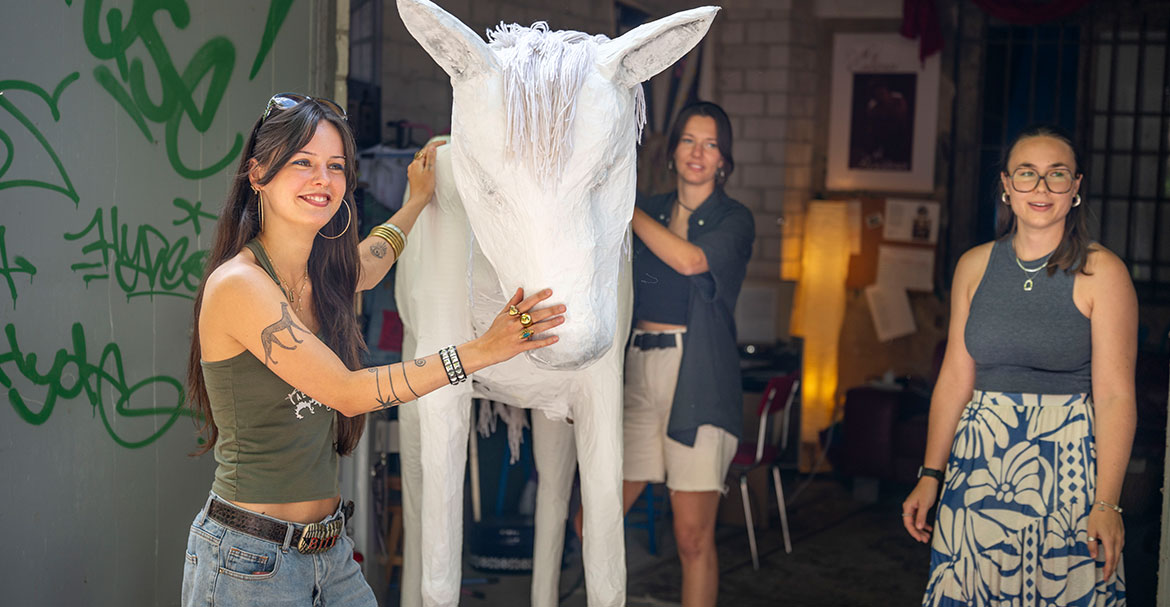
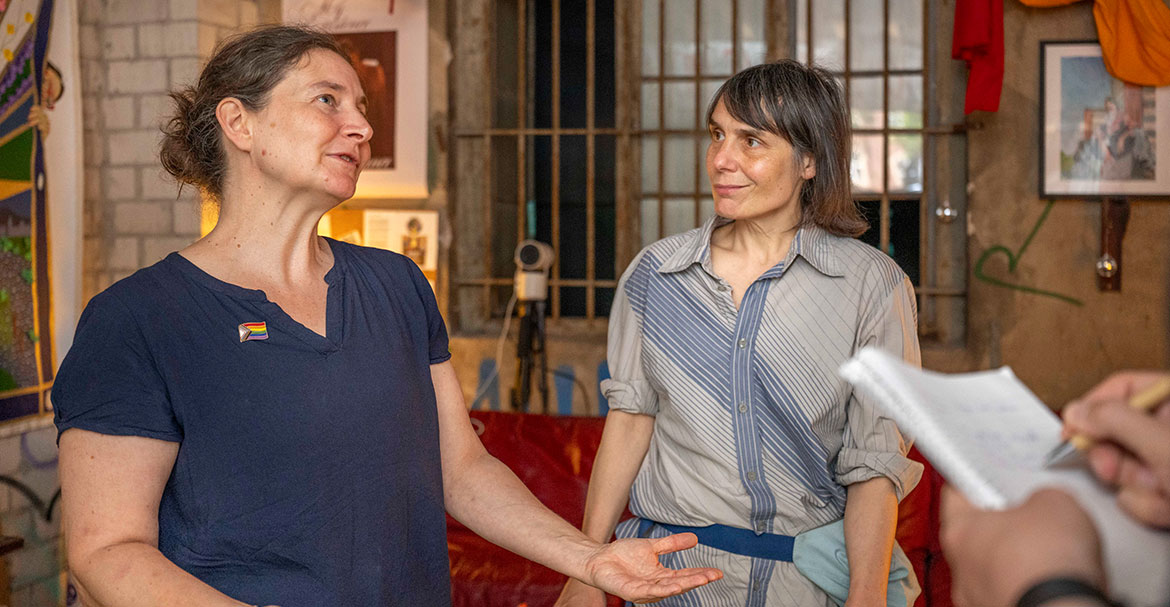
Art students from the university had also made their way up the hill to present an exhibition in the form of a shared apartment under the theme “Protest and Poetry,” which had been created in courses taught by Prof. Dr. Maja Linke and lecturer Karen Winzer. “We both taught courses during the summer semester that explored protest in artistic practice. In the process, we noticed that the students have many concerns and experience the full range of emotions associated with them: anger, fear, concerns, and even love,” Prof. Linke explains, standing between a life-size papier-mâché horse and a desk covered with sticky notes.
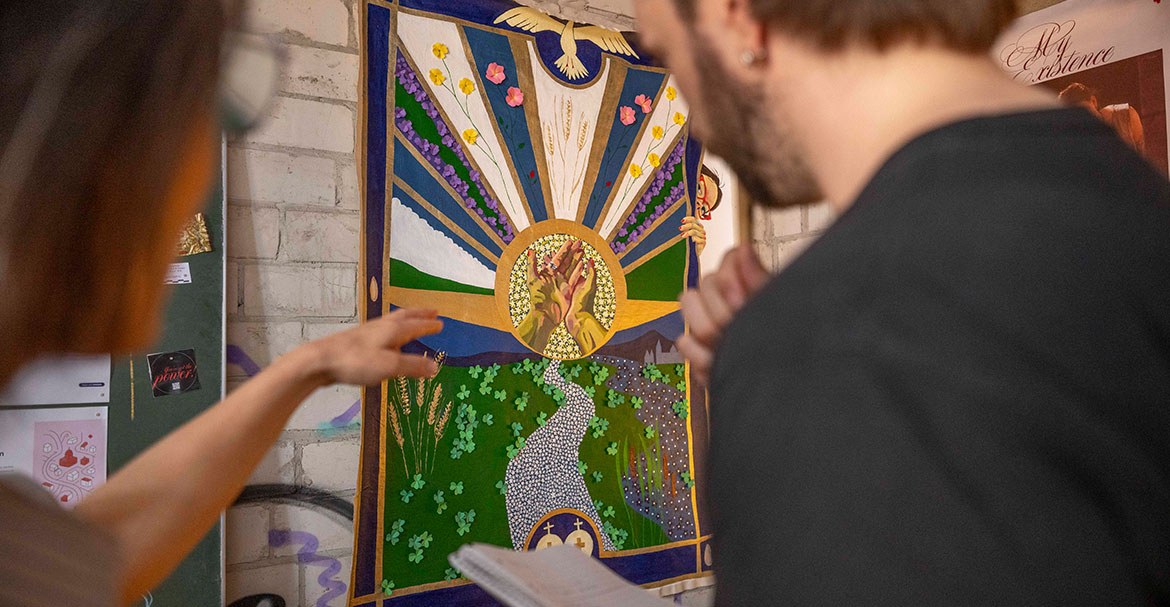
The group’s concept was a perfect fit for the Localize 2026 call for entries and its motto, “The Power of Love.” It quickly became clear that protest does not necessarily have to be directed against something. One student, for example, exhibited an elaborately designed Lenten cloth in blue, white, and gold. “In her work, she explores her faith, which she had kept largely hidden for a long time. She is demonstrating her faith,” Winzer says, reminding the audience that the word ‘demonstrate’ comes from the Latin ‘monstrare,’ meaning ‘to show.’ In its literal Latin sense, ‘protest’ also means to bear public witness to something.
Other members of the group explored the legal aspects of protest, reading the Act on Assemblies and Processions with its legally watertight bureaucratic language. “In the process, we learned, for example, that demonstrations and counter-demonstrations must be at least a stone’s throw apart,” Winzer reports with a smile. While reading, they also had the idea for the white horse, completed with a red border running all the way around the ceiling of the shared apartment’s room. The inscription read: “If I happen to express my opinion while accompanied by more than two politically tattooed horses wearing balaclavas and hats, what distance must be maintained between the horses?” Even the Potsdam police had no answer to this question when the students called to inquire.
Intervening and Helping Shape the Project
While some students were preparing a light lunch on the sofa with a sandwich maker, Linke explained how the works in the shared apartment came about: “We asked the 26 students: ‘If you could address all the issues on your minds, what would you say? And to whom?’ Art allows us to reflect and speculate; it can intervene in and help shape the world.” The students were encouraged to develop a feel for this potential so that, as future teachers, they could inspire critical reflection among their students on the world around them. “The students aren’t under pressure to sell their art. This allows them to express themselves more freely and choose their themes more independently,” Prof. Winzer explains. The result was a diverse array of artworks for the shared apartment – sometimes introspective, sometimes imperative, as large as a horse or as small as stickers bearing personal slogans. But always as a form of protest making public statements, and as poetry that replaces worn-out slogans.
The Power of Love
In general, many of the festival’s contributions were explicitly political and engaged – sometimes more, sometimes less directly – with the turbulent and eventful history of the site. Visitors who climbed the dilapidated staircase to the imposing building complex were greeted by a long row of funnel-shaped loudspeakers, which blended radio broadcasts from the 1930s in various languages into a cacophony of propaganda. An “Anti-Fascist Bouncy Castle,” modeled after Hambach Castle, stood around the corner. It also served as a stage for performances and panel discussions. Passing what was presumably the city’s largest sandbox, visitors entered the building’s courtyard – the central festival grounds – where, among other things, the performance “Marx in Love” by the Berlin theater collective Panzerkreuzer Rotkäppchen was staged.
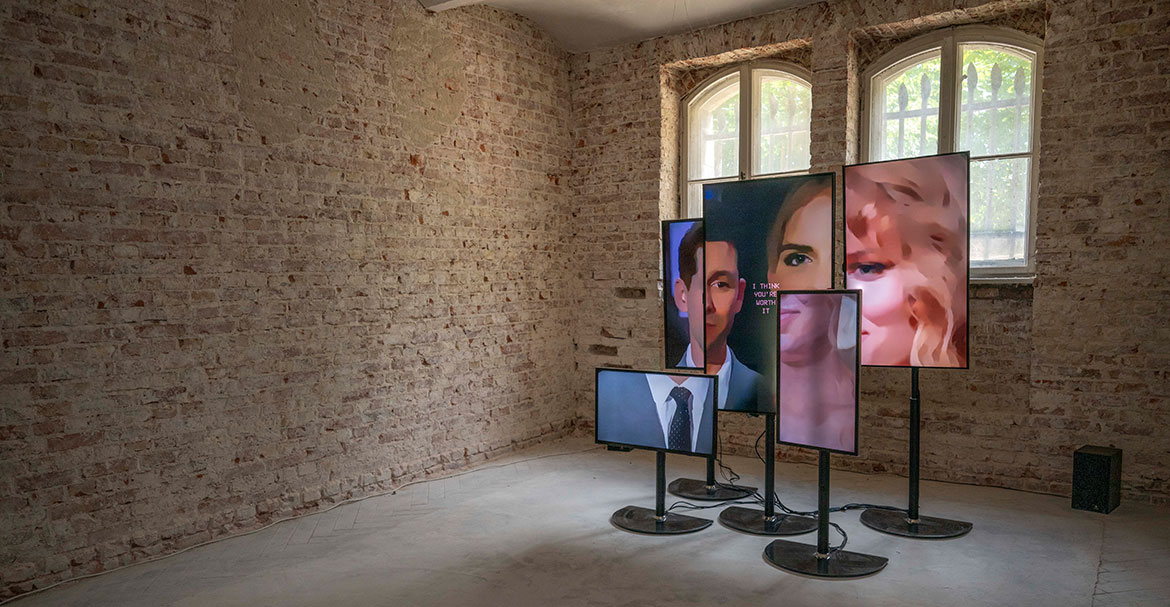
A singer performed Jennifer Rush’s “The Power of Love”, while a woman in a Trabant read aloud from Christa Wolf’s “Was bleibt” and a giant inflatable head of Karl Marx was rolled across the square. Visitors could also explore the building itself. Equipped with helmets, curious visitors descended a staircase into the former archive in the basement, where further installations invited them to look around and, in some cases, participate. At one stand, visitors could have their photos taken and “enhanced” using artificial intelligence. In the adjacent rooms, porcelain baseball bats raised questions about violence and fragility; overlapping screens displayed distorted declarations of love from reality shows, while printers, scanners, and other office equipment “sang” their melancholic songs in unison. Ascending from the basement, visitors could catch a glimpse of the central staircase in the building’s entrance hall. Here, small butterfly sculptures hung suspended from wires – an allusion to the philosopher and critic Walter Benjamin, whose family owned a summer home on Brauhausberg. In an episode of his autobiographical work “Berlin Childhood around 1900”, he writes, “Thus the word ‘Brauhausberg’ trembles through the butterfly-filled air.”
The festival grounds offered a sense of the scale of the future Brauhausberg Campus. Student housing is an integral part of the plans here. This is a highly relevant issue for students in Potsdam. It was therefore no coincidence that the group “Protest und Poetry” presented its works in a shared apartment.
Watch the video „Protest & Poesie auf dem Brauhausberg“
Prof. Dr. Maja Linke has been a professor of artistic practice with a focus on painting and graphic arts at the University of Potsdam since 2023.
Karen Winzer is a member of the artistic and academic staff in the Chair of Artistic Practice.
This article was originally published in Portal - Zwei 2026 „Wasser“, the University of Potsdam magazine.