
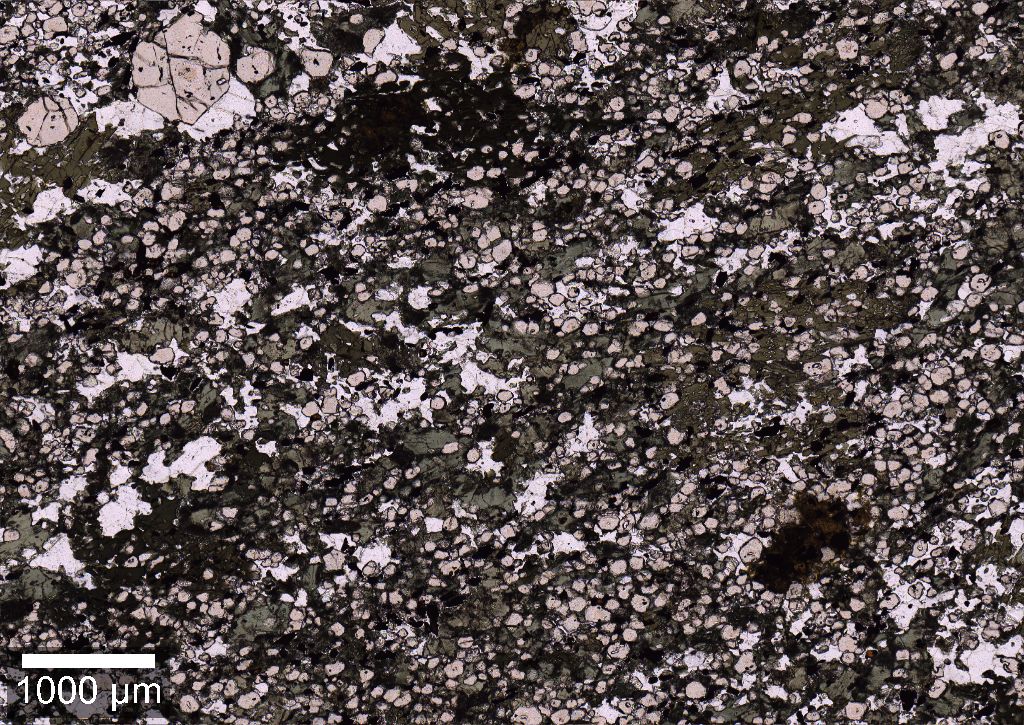
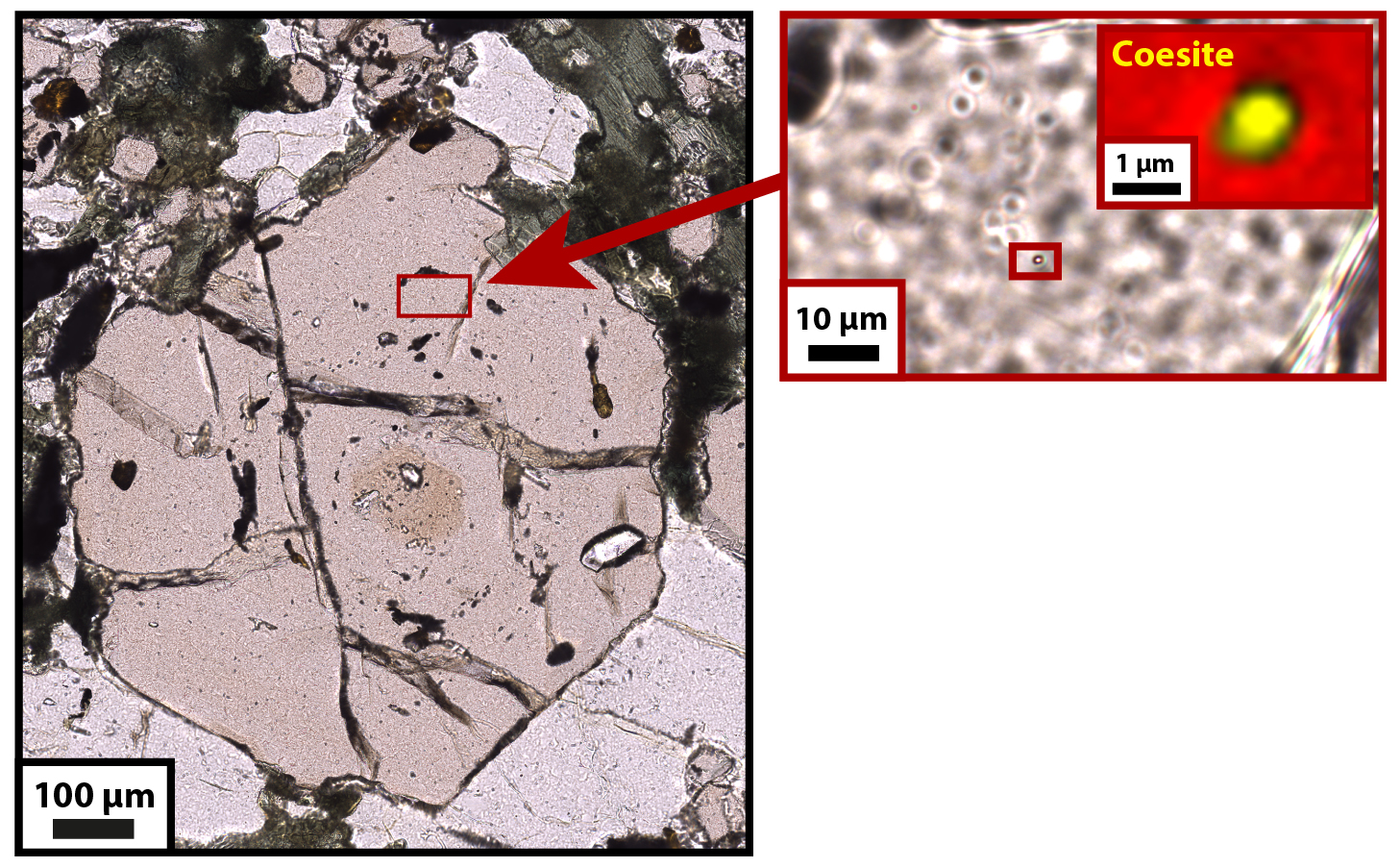
Subduction zones are sites for earthquakes and volcanic activity and are also responsible for Earth’s long-term climate stabilization over millions of years – acting as a recycling valve for molecules like carbon dioxide. Due to the high pressure in subduction zones, a red-and-green coloured rock called eclogite forms. The researchers investigated such an eclogite from Papua New Guinea by a combination of cutting-edge techniques, whereby at the Institute of Geosciences of the University of Potsdam, electron microprobe analysis was performed to determine the mineral chemistry, and micro-Raman spectroscopy was used for a pre-investigation of inclusion assemblages and the analysis of glass in the re-homogenized melt inclusion. The finding of tiny inclusions of coesite – a mineral that requires ultrahigh-pressure conditions – trapped inside another mineral during the rock’s formation, led the researchers to conclude that the rock was deeply subducted, at least 90 kilometers below the Earth’s surface, and experienced temperatures of around 800 °C.
Most interestingly, they could reconstruct that temperatures were only 100 °C colder at half the depth, i.e. 45 kilometers. The rock was therefore much warmer than expected. Leading author Dr. Jan Schönig at Göttingen University’s Geoscience Center explains: “Finding this change from hot to cold subduction was unexpected as this contradicts our current thermal models of subduction zones.”
According to the researchers, this is the first time that a transition from shallow to deep depths, accompanied by a change from hot to cold subduction, has been shown so clearly. The possible explanations are: either rocks are getting much more heated at a shallow depth than previously assumed due to shearing stress at the plate contacts; or the subduction zone hadn’t yet had time to evolve to the lower temperatures expected; or a combination of both.
In the future, a better understanding of subduction processes may help to analyze their effects on earthquakes, volcanic activity, and major geochemical cycles like the long-term carbon cycle. This knowledge will also shed light on how subduction has been operating over millions to billions of years and continues to operate today.
Link to Publication: Schönig, J., Ferrero, S., Gresky, K. et al. Geothermal gradient change during subduction recorded by ultrahigh-pressure eclogite. Nat. Geosci. (2026). https://doi.org/10.1038/s41561-026-02110-1
Link to Press Release by Georg-August-Universität Göttingen: https://www.uni-goettingen.de/en/3240.html?id=8307