
Another summer of extremes has come to an end: Heat and prolonged drought caused devastating wildfires, parched fields, and falling water levels. What are the consequences?
Wagener: In addition to the danger to life and limb and immense economic damage, nature suffers the most. Entire ecosystems are threatened, and it has long been clear that the effects of climate change will continue to alter precipitation and evaporation patterns, with consequences for the water supply to vegetation, soils, rivers, and groundwater reservoirs. During increasingly frequent periods of drought, our dependence on water becomes particularly visible: when soil moisture in the fields declines, when water levels in rivers fall, affecting navigation, and also – as was the case last summer – when power plants face difficulties with cooling. The images of low water levels on the Rhine and Danube are still fresh in our minds.
Another extreme is more frequent heavy rainfall, which can cause rivers to overflow their banks and flash floods to sweep away bridges and homes. How can we better assess such risks?
Wagener: We need to redefine the concept of risk. It makes less and less sense to describe these events as “once-in-a-century” occurrences. That suggests a certainty about our ability to classify these events – a certainty we no longer have in the age of climate change. Until now, we’ve tried to predict future events based on historical measurements. That has always been difficult, but it no longer works today. We therefore use computer models to simulate stress tests, for example, and thereby prepare ourselves for a much wider range of possible future events. And we must accept that we will have less certainty about how much water will be available and what extremes will occur.
How can we still make the predictions that are necessary to manage water consumption effectively?
Wagener: To understand the water cycle under the constantly changing conditions of climate change, we need better computer models and equally good methods for interpreting and testing them: Are the predictions accurate because the models truly reflect the underlying processes? It is not easy to answer this question, since the available data is currently very heterogeneous. Measurements mostly come from wealthy countries with good infrastructure and are less frequently available from poorer regions of the world. In addition, we have difficulty measuring everything that flows underground – such as how much rain finds its way into the groundwater. So we have a significant imbalance in our data, both spatially and in terms of the processes involved.
How do you deal with these gaps in the data network?
Wagener: An important approach to closing data gaps is to draw on the experience of hydrologists. If there are no specific measurement series for a region, we look for someone who has worked in that or a similar region. Several people often work together to estimate which processes and dynamics we can expect there. So we try to build an experience-based model that we can gradually improve with new data.
When you were awarded an Alexander von Humboldt Professorship in 2021, you moved from Bristol to the University of Potsdam. Why Brandenburg?
Wagener: Because water research is particularly strong here and the issue of water is highly relevant. This is often the case in regions where water problems are significant and the population recognizes their regional relevance. The same is true of Tucson, Arizona – a semi-arid region that was the first in the U.S. to establish a degree program in hydrology. Here in Potsdam, we have a very broad research base; we investigate not only the processes underlying water extremes but also their impacts on nature and society. In addition, we are able to collaborate with a large number of non-university research institutes – a unique network. The involvement of non-university institutes such as the GFZ Helmholtz Centre for Geosciences and the Potsdam Institute for Climate Impact Research – among many others – is a major advantage of being based here.
Brandenburg has more rivers and lakes than almost any other federal state in Germany. At the same time, it is considered an arid region. Is this a paradox?
Wagener: There is little precipitation here, and what little we have isn’t retained by the sandy soil but quickly drains into the groundwater and then into the highly visible bodies of water. At the same time, this region is prone to heavy rainfall. However, these downpours occur in summer, when evaporation is higher. With rising temperatures and longer growing seasons as a result of climate change, evaporation is increasing anyway. That, too, is one of the reasons why groundwater levels are falling and less water is available.
What are the consequences?
Wagener: The result will be long-term conflicts over water use, for example between industry and agriculture, private individuals, and cities. There will be increasingly frequent shortages, when, seasonally, people simply want to withdraw much more water than is sustainably available. To make the necessary decisions in such situations, we need sufficient evidence, i.e., enough data on how much water is available and can be used sustainably and, above all, how much is actually being used.
Don’t we already know that?
Wagener: We don’t always know how much water certain industrial sectors use or how much is withdrawn from private wells. Due to long periods of drought and rising water costs, for example, using private wells is becoming increasingly attractive. We need a transparent discussion about who uses how much water, how we want to allocate it, and what the consequences are when people don’t have access to water. As evaporation continues to rise, the proportion of precipitation that we can use is getting smaller and smaller. At the same time, demand in industry and agriculture is increasing. This inevitably leads to problems.
What can be done to keep water in the landscape?
Wagener: Rewetting wetlands, protecting floodplains, and further developing urban areas as “sponge cities”. There are many ways to let the landscape act as a natural reservoir. If we restore the ecosystem services provided by nature – which we have reduced in the past – we won’t need to replace them with infrastructure.
The Potsdam WaterHub, established at the University of Potsdam, aims to research these problems in all their complexity. How are you proceeding?
Wagener: The WaterHub offers Brandenburg’s water research community the opportunity to exchange ideas across institutions and disciplines and to initiate innovative collaborations. To this end, we’ve launched the “Potsdam Water Talks.” In these seminars, experts contribute diverse professional perspectives to stimulate discussion on water, the environment, and society. After all, a university’s great strength lies in the diversity of its knowledge. That’s why the Hub also includes representatives from political science, law, the social sciences, and economics to contribute to sustainable solutions.
And how does this collective knowledge translate into practice?
Wagener: Through dialogue with decision-makers in politics and business, as well as with the public, to convey the complexity of water issues – and the role each individual plays in them. On the WaterHub website, we explain Brandenburg’s hydrology and answer frequently asked questions about droughts and wildfires, heavy rainfall, and flooding. We will publish “Potsdam Water News” regularly and, of course, share the latest research findings in our teaching, for example in the international master’s program “Climate, Earth, Water, Sustainability.” One advantage is that the university trains teachers. So we can work with our colleagues in geography education to find ways to incorporate the latest knowledge into school curricula.
What exactly is the role of each and every individual? How can we conserve water?
Wagener: With an average of 125 liters per day, we use less water in this country than we used to. However, our indirect consumption is much higher and often draws on water from regions that are far more water-scarce than ours. We need to be clear about how many resources are required to produce the goods and food we consume. For example, one kilogram of rice requires about 3,000 liters of “virtual water.” The same amount is used to manufacture, package, and transport a T-shirt. Even though we can’t see this virtual water, we can understand these connections and act accordingly. Changing our consumption patterns – by buying locally, seasonally, and frugally – would have a much more positive global impact than saving water regionally.
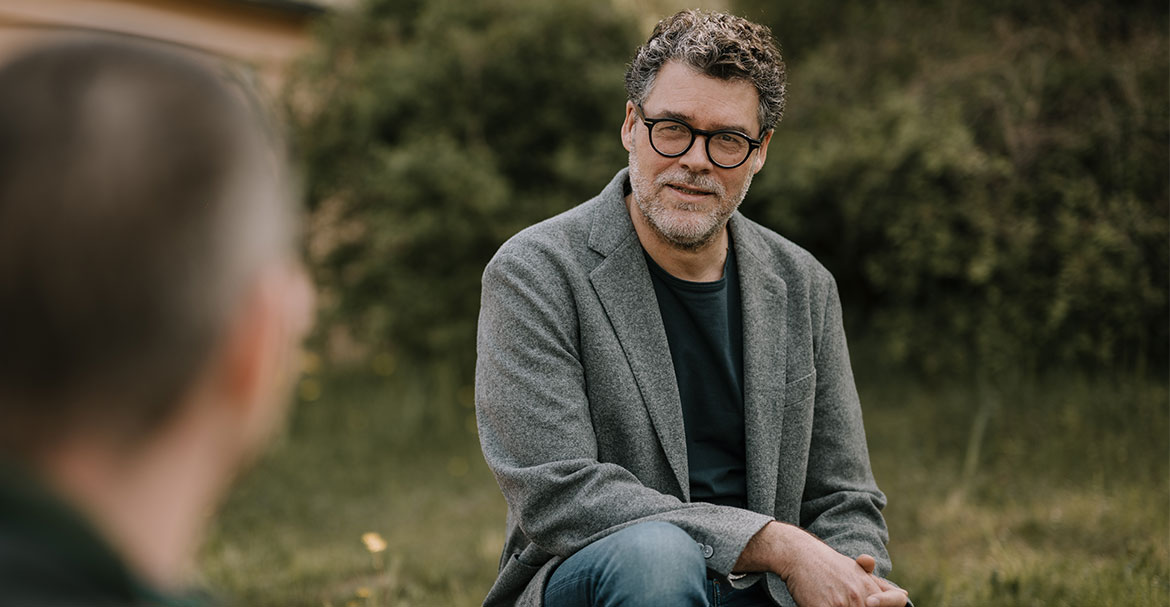
Prof. Dr. Thorsten Wagener
In 2021, he joined the University of Potsdam as an Alexander von Humboldt Professor, where he has since headed the Research Group for the Analysis of Hydrologic Systems at the Institute for Environmental Science and Geography. His tools for global sensitivity analysis and his diagnostic approach to model evaluation are used worldwide to improve the reliability and interpretability of hydrological models. In recognition of his outstanding research achievements, his leadership, and his dedicated work in the field of hydrology, Thorsten Wagener was awarded the John Dalton Medal in 2026 by the Hydrological Sciences Division of the European Geosciences Union.
This article was originally published in Portal - Zwei 2026 „Wasser“, the University of Potsdam magazine.