
“Floodplains are invaluable because they fulfill unique ecological functions,” the researcher explains. “They provide ideal conditions for organisms that depend on water, as well as for those that live on land.” In floodplains, these systems interconnect, promoting the migration and exchange of species and contributing to increased biodiversity. In addition, floodplains play an important role in regulating nutrient and water cycles. Floodwaters bring in abundant nutrients, which certain plants and organisms use efficiently. “This diversity of life forms and processes creates a dynamic and stable environment that is robust enough to buffer various ecological disturbances.”
These areas are essential not only for biodiversity, but also for the many ecosystem services they provide. Among other things, floodplains act as natural flood buffers, absorbing large volumes of water and gradually releasing it again. They also play a key role in the water cycle and influence groundwater levels, thereby offering both ecological and economic benefits. In one of her research projects, Natho investigated the so-called ecosystem services of river floodplains. In other words, she quantified the services provided by nature. “In addition to biodiversity, these include nutrient retention, carbon sequestration, flood retention, and, of course, providing places for recreation.”
Frequently Altered and Transformed
Despite their enormous importance, floodplains are often underestimated and neglected. Over centuries of human land use, they have repeatedly been degraded, transformed, and stripped of their natural functions. Floodplains began to form during the Ice Age, when vast glaciers carried enormous amounts of water and sediment as they melted. These processes formed the so-called glacial valleys, in which rivers and their floodplains are located today. Increasing human intervention has dramatically altered their appearance. Many rivers have been straightened, and floodplain areas have been drained to make them suitable for agriculture. As a result, these areas have lost their natural function as buffer zones and a significant part of their biodiversity. With their changing water levels, undisturbed rivers and floodplains provide habitats for a wide variety of plants and animals, for example along meandering river courses that form where river gradients are gentle. On the outside bend, the water flows faster, gradually eroding the bank and creating a steep edge. Coarse material is primarily deposited here. On the inside of the bend, where the water flows more slowly, finer sediment tends to accumulate. “Different animals live in coarse gravel than in fine sand,” Natho says. “These are very different habitats that no longer exist at all in a channelized river.”
The constant interaction between water and land, dry conditions and flooding also creates the distinctive biodiversity and biological activity of floodplain landscapes. “The ebb and flow of water is essential for the characteristic conditions in floodplains. The vegetation and organisms are adapted to these changing conditions,” she says. And not all floodplains are the same. “They can be wet, but also hot and dry; they exist in alpine regions as well as in the North German lowlands. I’ve always been fascinated by the astonishing variety of habitats found within such a small area.”
Stephanie Natho studied in Karlsruhe under Professor Emil Dister, who had earned a reputation as the “floodplain guru.” She moved to Brandenburg in 2015 and has studied the condition of the region’s floodplains ever since. Her conclusion: the situation is bad. Brandenburg has many bodies of water, and therefore also many potential floodplains. But drainage has played a major role here, too, leaving many of these valuable landscapes in a degraded state. That is a particular problem for Brandenburg. “People say Brandenburg is rich in bodies of water but poor in water.” Rain quickly seeps into the region’s sandy soils, and there are too few places able to store large amounts of water for long periods. Floodplains, like intact bogs, could change that.
140 Hectares of Floodplain Forest Planted
“With the right conservation measures and restoration projects, such as this one, Brandenburg could once again become an ideal place for intact floodplains,” the geoecologist says. Since 2010, the largest project of its kind in Europe has been underway in the region: the restoration of the Lower Havel. The Nature and Biodiversity Conservation Union (NABU), which is carrying out the work, reports that it has removed 26 kilometers of riverbank protection, reconnected 23 oxbows, restored 746 hectares of floodplain, reactivated 63 flood channels, and planted 140 hectares of floodplain forest.
Natho is closely involved in the project. She is studying floodplain conditions before and after restoration in six selected areas. Since 2025, she and a group of master’s students have been testing a method developed at the University of Duisburg-Essen. The method is designed to assess the ecological condition of landscapes after restoration. The research team is particularly fortunate: The University of Potsdam’s Ecological Station is located near the small village of Gülpe, right in the middle of the restoration area. From there, Natho and her students regularly spend many hours over several weeks at different sites along the Havel river. They observe, record, and count so-called indicator species – animals whose presence can reveal the state of biodiversity in the floodplain landscape. “We focus on birds and amphibians,” she explains.
Nura Alaya looks – and listens – exclusively for birds. In the spring of 2026, she spent several days surveying birds at sunrise on six separate occasions along the Havel in Gülpe and the surrounding area. “It’s really something special to wade through waist-high water in a restored floodplain and observe specialized waterbirds as the sun rises,” she says. The student is testing various methods for surveying birds, that is, determining when and where specific species are active. For her master’s thesis, she is specifically investigating whether audio recorders can be helpful in this process. After all, if surveys rely exclusively on field observations at sunrise, some species may go undetected because they are less active at that time. The student placed a total of 15 recorders in the floodplain areas. From March to June, they recorded the surrounding sounds at sunrise, during the day, and at night. “Even though the data analysis hasn’t been completed yet, it’s already becoming clear that the audio recorders captured some species that we hadn’t recorded before,” she says.
On the right track
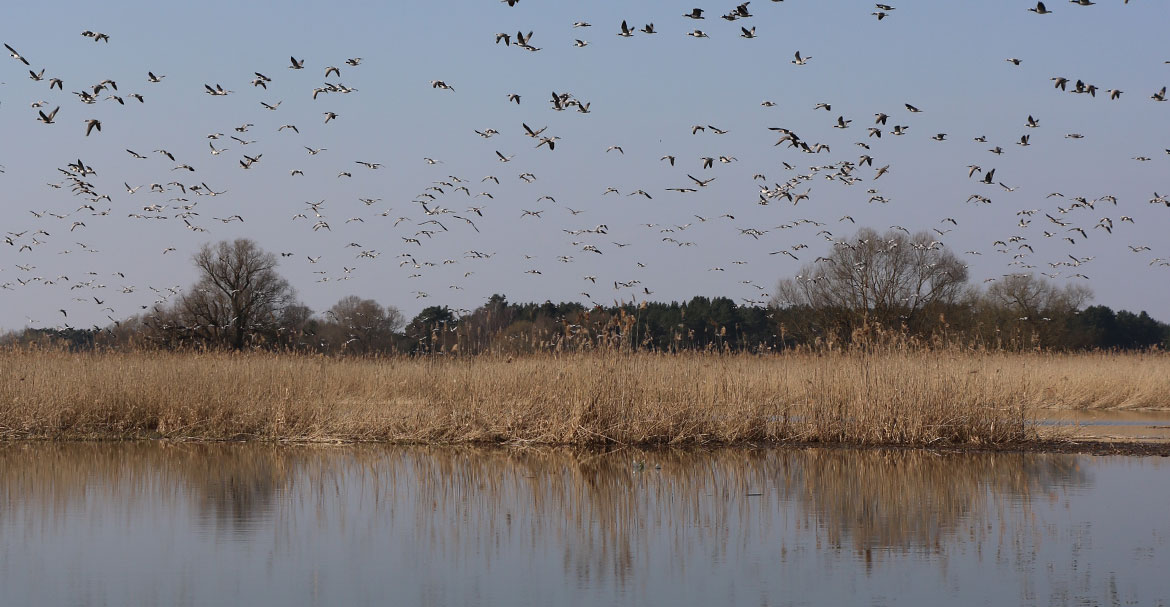
Overall, the Potsdam research team has now been able to demonstrate that, thanks to the flooding – the main goal of the restoration efforts – the Havel floodplains provide valuable habitats for birds in general and for species that depend on floodplain environments in particular. “We have already identified 99 bird species, including 47 rare, threatened, and/or protected species, such as the common tern, the corncrake, the osprey, and the white-tailed eagle. Their presence underscores the ecological significance of these measures.” At the same time, the researcher emphasizes that there is still a long way to go toward a largely natural floodplain landscape, even in the Lower Havel restoration area. “The river continues to be regulated by numerous weirs, which prevents it from flowing naturally.” On the other hand, it is precisely this combination of flow regulation and restoration that makes the Lower Havel unique, as Natho explains: “During the winter months, the water level is raised, causing the floodplains to be inundated.” This allows groundwater reservoirs to be replenished, helping the soils retain moisture even when summer brings little precipitation.
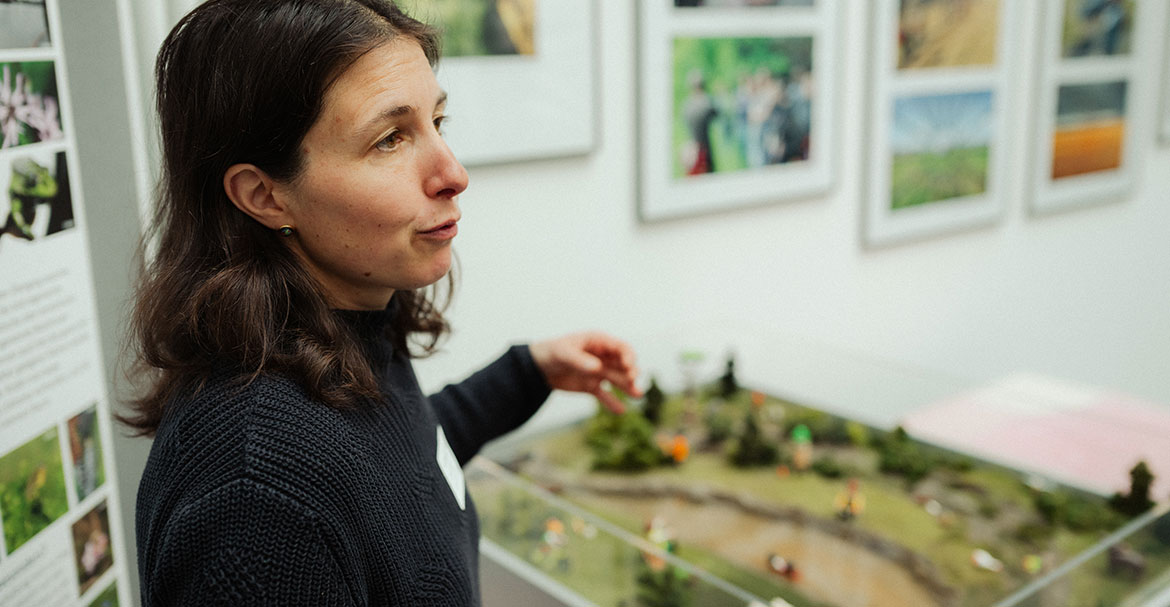
Dr. Stephanie Natho is head of the Landscape Management Research Group at the Institute of Environmental Science and Geography of the University of Potsdam.
Nura Alaya is conducting research for her master’s thesis in the Lower Havel nature restoration area.
This article was originally published in Portal - Zwei 2026 „Wasser“, the University of Potsdam magazine.