News from the University of Potsdam

Subjects
Selected Subject:
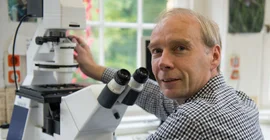
While the invasion of plants and animals has been widely examined, microorganisms have received little attention. At the University of Potsdam, PD. Dr. Guntram Weithoff and his team will contribute to filling this gap. Photo: Karla Fritze

Who Is the Strongest? – Team of biologists is looking for the invasive success of blue-green algae


The Himalayan balsam (Impatiens glandulifera) has succeeded. So has the Chinese mitten crab (Eriocheir sinensis). Both belong to the plant and animal …
Konfokalmikroskopische Aufnahme des Herzens eines Zebrafischembryos. Der Verlust eines bestimmten Proteins führt zu einer ballonartigen Vergrößerung des Herzschlauchs (rechts). Fotos: Salim Seyfried und Marc Renz.

Die Suche nach dem Wirkstoff – Potsdamer Zoophysiologen untersuchen seltene Erkrankungen

Salim Seyfried, Professor für Zoophysiologie an der Universität Potsdam, koordiniert ab Juni 2015 ein transatlantisches Konsortium, das seltene …

Bakterienkompass und organische Solarzellen – Auszeichnungen für Nachwuchswissenschaftler

Beim 19. Leibniz-Kolleg Potsdam an der Universität Potsdam werden heute zwei Nachwuchswissenschaftler für ihre herausragenden Leistungen geehrt. Den …
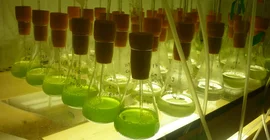
In their experiments the researchers grow the algae under specific conditions. Picture: Elly Spijkerman

A Question of Transport – Microalgae Fixate Carbon Dioxide

They are invisible to the naked eye. Only in massive quantities do they color water green. Aquatic microalgae are tiny organisms, which usually …

Landwirtschaft und Ernährung – deutsch-japanisches Symposium in Golm

Um Landwirtschaft und Ernährung geht es bei einem deutsch-japanischen Symposium, das am 8. und 9. Mai 2015 an der Universität Potsdam stattfindet. …

Bewohnbare Planeten und extraterrestrisches Leben – Leibniz-Kolleg an der Universität Potsdam

Gibt es Leben außerhalb der Erde? Und welche Voraussetzungen müssten dafür erfüllt sein? Dieser Frage geht der renommierte Mineraloge und Astrobiologe …
Björn Huwe and Annelie Fiedler made the moss fit for space. Foto: Annelie Fiedler

Surviving in Space – Why There’s Moss on the ISS

All the lights on campus are off. Only in Björn Huwe’s office a screen is flickering. The biologist is sitting at his desk in the institute building …
Silke Leimkühler, (Foto Karla Fritze)

Kein Leben ohne Eisen und Schwefel – Neues DFG-Schwerpunktprogramm wird an der Universität Potsdam koordiniert

Prof. Dr. Silke Leimkühler, Professorin für Molekulare Enzymologie am Institut für Biochemie und Biologie der Universität Potsdam, koordiniert …
Jadewein (Strongylodon macrobotrys) (Foto: Michael Burkart)

Löwenschwanz-Agave und Jadewein – Seltene Blühereignisse im Botanischen Garten

Mehr als fünf Meter hat sie ihren Blütenstand in die Höhe getrieben: die Löwenschwanz-Agave (Agave kerchovei) im Kakteen- und Sukkulentenhaus des …
Two levels of fluvial terraces overgrown with vegetation. Today’s riverbed lies a few meters lower than during the time the fluvial terraces were formed. Picture: Taylor Schildgen

On Precipices – Landscape Response to Climate Change

Landscapes change over hundreds of thousands, even millions of years. Tectonic events and erosion create mountain ranges and remove them again. The …