News from the University of Potsdam

Subjects
Selected Subject:
Three apparently unhappy examiners ask the test subject to solve difficult problems and pose uncomfortable questions.

Stress Fest at the Stress Test – A visit to Prof. Dr. Pia-Maria Wippert’s laboratory

A plain and white-painted room in the historic building no. 12 at Neues Palais, one table, three chairs. Nothing suggests that things are about to get …
Bank voles were introduced to Ireland from Central Europe in 1920 and have continued to spread across the island ever since. At several locations (black dots), the behavior of individual animals was studied. Individuals in the expansion zone (orange) are more careful and less active than animals in the established zones (green), but they also explore more extensively.

Careful Pioneers – How Animals Spread and How Their Behavior Changes in the Process

Invasive animal and plant species are a challenge for biodiversity all over the world. To better understand the actual expansion processes during a …
Uni-Präsident Prof. Oliver Günther, Ph.D.

“Ambitious But Not Presumptuous” – President Oliver Günther about research excellence at the University of Potsdam

The University of Potsdam wants to establish itself in the top tier of international research universities. For this purpose, it has submitted three …
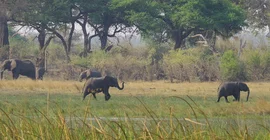
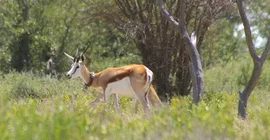
African antelopes seeking for shady places during phases of extreme heat

Keeping cool – how African antelopes respond to the climate crisis

The climate crisis is turning the temperature up all over the world, but in southern Africa, the rise has been particularly concerning. Scientists …
The walk-in sample chamber from the "DynaTrait" project.

Diversity Provides Stability – In the Priority Program “DynaTrait”, biologists combine mathematical models, field studies, and laboratory experiments to explore how nature works

It is comfortably warm and bright in the climate chamber. At first glance, you don’t see that the numerous glass flasks filling the illuminated …
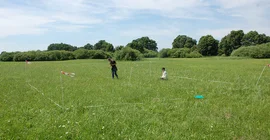
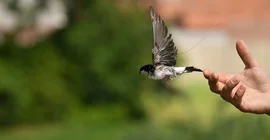
Behavioral experiment with wild rodents.

“We Recognize Animals as Individuals” – Researchers of the University of Potsdam investigate the personalities of wild animals

Jana Anja Eccard knows her mice well. For 27 years, she has been researching the behavior of small rodents in numerous experiments, both in the …
“The three phases of exceptional dynamics: (1) Predation on the unprotected bacteria by predators, (2) toxin formation as cooperative defence and recovery of the bacterial population, (3) filament formation as individual defence through evolution and stabilisation of densities”.

In the end, it’s the individual advantage that counts – Bacteria rely on cooperation and evolution in order to defend themselves against predatory protists

Eating and being eaten is a normal process in nature. These predator–prey dynamics help to stabilise ecosystems. It ensures that individual species do …
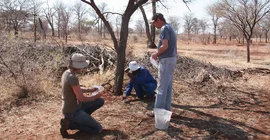
Installation of a solar-powered telemetry base station.

With Kudu, Eland, and Springbok – How Wildlife Management Can Help the Savanna

The savanna: individual groups of trees stand picturesquely on wide plains, large herds of wild animals pass by, watched vigilantly by prides of lions …
Schädel einer toten Kuh auf einem Feld.

Global network initiative investigating drylands

University of Potsdam researchers have contributed to a global study that assesses ecosystem services in drylands. The international team led by …
Prof. Dr. Dieter Neher (left) and Prof. Dr. Bernd Müller-Röber (right)

The Best in the World – Scientists from the University of Potsdam Again Among Most Cited Researchers

Two scientists from the University of Potsdam are among the absolute top group of the most cited researchers in their field worldwide. This year’s …