News from the University of Potsdam

Subjects
Selected Subject:
Graduates of our international master's degree program CLEWS will be trained to become experts in the field of climate science research in order to address the consequences of global warming in a science-based manner with regard to research, politics, and the public. | Image: Vera Öztürk

CLEWS – International master's program on climate, earth, water and sustainability launches

The University of Potsdam offers for the first time this fall an interdisciplinary master's program that will directly address the most pressing …
Left- and right-styled flowers of Wachendorfia paniculata. The blue arrows indicate the styles, the orange arrowheads the anthers. Two of the three anthers are bent to the other side than the style. | Credit: Michael Lenhard

Prof. Dr. Michael Lenhard receives Human Frontier Science Program Award

Together with an international team of scientists Prof. Dr. Michael Lenhard from the University of Potsdam was awarded a Research Grant of the …
PhD student Nastasja Grdseloff and Prof. Salim Seyfried assessing light sheet microscopy images | Photo: Kevin Ryl

Searching for a common denominator – Research network “V.A. Cure” investigates rare diseases

How do you research rare diseases for which there is no lobby? With the help of zebrafish, Potsdam University’s physiologist Prof. Dr. Salim Seyfried …
Brown hare with transmitter | Photo: Carolin Scholz

Where the hare runs – How animals’ movements contribute to biodiversity in agricultural landscapes

The preservation of biodiversity is a social mandate. In the Research Training Group "BioMove" at the University of Potsdam, experienced experts are …
The only mounted skin of a female blue antelope can be found in the Natural History Museum Vienna. | Photo credit: NHM Vienna, Alice Schumacher

Blue and Lonesome – The rarity of blue antelopes in museum collections

Genetic research has shown that far fewer specimens of the blue antelope exist in museum collections than previously thought. An international team of …
The possibilities of molecular biology are developing rapidly. | Photo: AdobeStock/ipopba

Scissors for Genetic Material – Lena Hochrein optimizes molecular methods

The possibilities of molecular biology are developing rapidly. Today, researchers are able to modify the genome of every cell quickly, economically, …
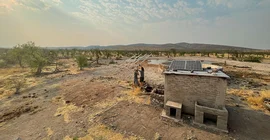
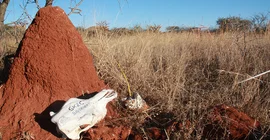
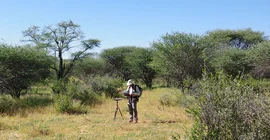
The research team in Namibia | Photo: Olwen Evans

Where Kudu and Springbok Live – Researchers from Potsdam examine if good wildlife management can help the savanna

The savanna is in danger. The African grasslands - picturesque groups of trees on wide plains, large herds of wild animals passing by, vigilantly eyed …
White storks in the field | Photo: Guillermo Fandos-Guzman

Flexible individuals - Seasonal climatic niche tracking in White Storks only emerges at population level

Individual migratory birds rather track short-term weather conditions, while a population adapts its migratory movements seasonally to both weather …
Bioreactor for cultivating microorganisms in the innoFSPEC lab | Photo: Ernst Kazcysnki

Not Without Alternatives – Bioplastic made from waste replaces conventional plastics

Plastic is a part of our everyday life. It has been made from oil, natural gas, and coal for over 100 years. The negative consequences of this flood …
In the embryonic zebrafish heart, the endocardium that is forming cardiac valve leaflets is divided into two subpopulations (here, cyan and yellow). | Photo: Federica Fontana

Strong evidence – Essential regulatory gene for the formation of heart valves discovered

By studying zebrafish embryos, the animal physiologist Prof. Salim Seyfried and his team have identified a new blood flow-regulated gene (Vegfr3/Flt4) …