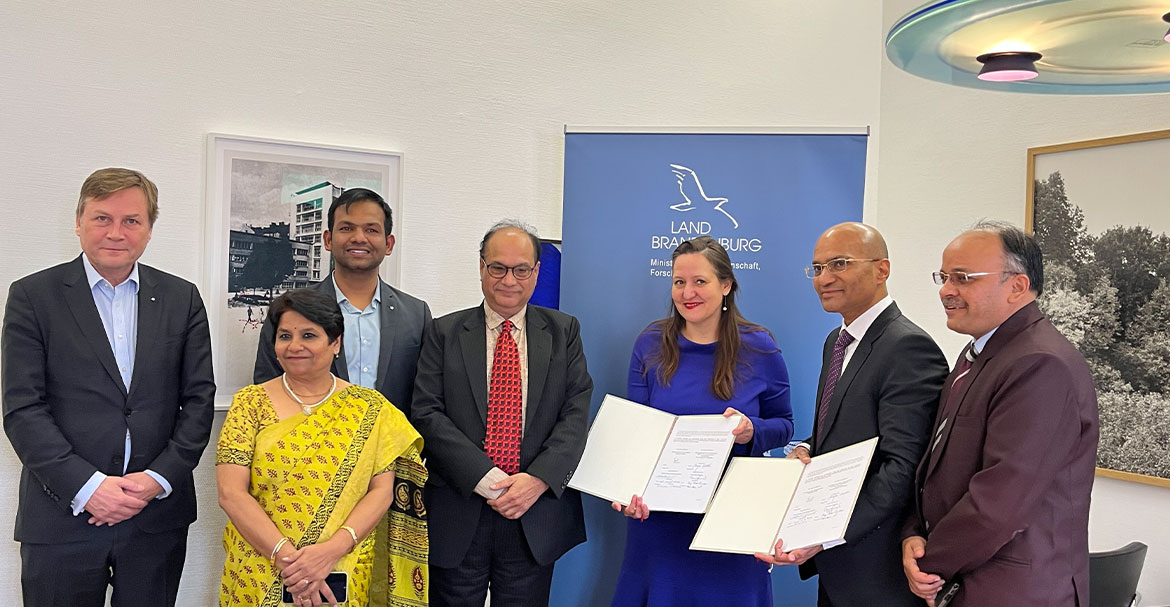
The event was attended by Prof. Oliver Günther, President of the University of Potsdam, Prof. Wolfram Berger, Vice-President for Internationalisation at the Brandenburg University of Technology Cottbus-Senftenberg (BTU) and Prof. Axel Bronstert (UP), as well as Prof. Tripta Thakur, Vice-Chancellor of Veer Madho Singh Bhandari Uttarakhand Technical University, Prof. Kamal Kishore Pant, Director of the Indian Institute of Technology (IIT) Roorkee, Prof. Vimal Chandra Srivastava and Prof. Ankit Agarwal (both from IIT Roorkee).
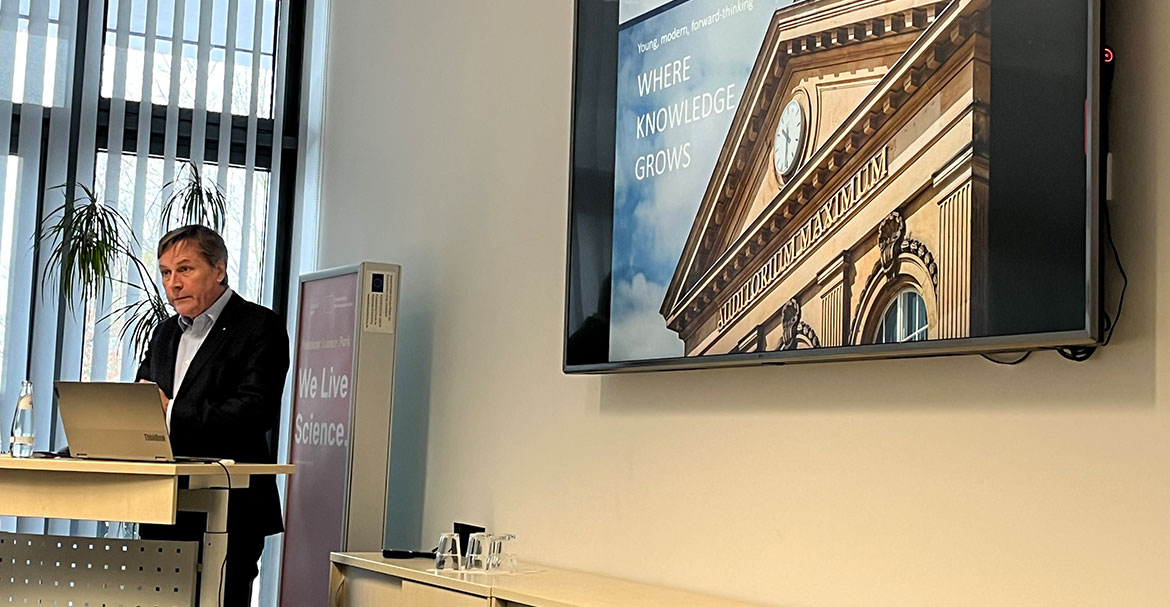
UP has been working closely with IIT Roorkee for many years. They share common research interests, particularly in environmental sciences and hazard research, which led to collaboration within the ‘NatRiskChange’ research group several years ago. In addition, researchers from both institutions are working closely together on the Co-PREPARE environmental science project to better assess natural hazards and the associated risks in Europe and the Himalayas. In future, the two research institutes intend to work even more closely together and extend their collaboration to other disciplines and topics. There are also plans for more intensive exchange in the field of knowledge and technology transfer, in which both IIT Roorkee and the University of Potsdam are national leaders. For this reason, this year's visit focused on the work of Potsdam Science Park – one of the leading science parks in the capital region – and its role as a hub for innovation, knowledge transfer and start-up creation. During the visit, the site management presented its comprehensive services to support research commercialization and start-up development. Among the newest companies in the park, DiGOS Potsdam GmbH presented its advanced precision measurement technologies in the fields of seismic monitoring and satellite laser ranging. Potsdam researchers from the fields of chemistry (hybrid nanostructures) and computer science (middleware, operating systems and computer networks) took part in the discussions to explore opportunities for future projects in other disciplines.
Minister of Science Dr Manja Schüle: "We see it every day: the world is changing rapidly. And we are facing challenges that require global solutions and international cooperation. Science and research are key to this. That is why the cooperation agreement we signed today is so important, promoting both innovation and entrepreneurship and building bridges between our cultures and societies. Indian students and researchers already play a major role at Brandenburg's universities and research institutions: their contributions are visible in almost all disciplines. I am convinced that with smart cooperation in areas such as disaster management, sustainable agriculture, clean technologies, new materials, computer science and environmental sciences, we can exploit the potential of our universities and research institutions even better – and benefit from each other! The agreement is a clear commitment to future-oriented, sustainable and inclusive scientific cooperation with exciting prospects for the development of joint projects. I am confident that together we will achieve a great deal!"
Prof. Dr. Wolfram Berger, Vice-President for Internationalisation at BTU: "The Joint Declaration of Intent opens up new perspectives for our university to expand international cooperation in India. In particular, the Indian Institute of Technology (IIT) Roorkee, located in the Uttarakhand region, has significant overlaps with all of BTU's profile areas. With over 20 departments, it offers an excellent basis for joint activities in research and teaching and at the same time underlines the strategic importance of India as a partner of the BTU. This was also impressively demonstrated by my personal visit in March 2025 and the constructive discussions on site."
For the Brandenburg University of Technology Cottbus-Senftenberg (BTU), India is an important partner in the context of internationalisation. The close and dynamic collaboration is reflected in partnerships with Indian universities in research and teaching. It is characterised in particular by bilateral mobility of students and scientists and includes joint future-oriented research projects in the four profile areas: global change and transformation processes, energy transition and decarbonisation, health and life sciences, artificial intelligence and sensor technology. With currently 1,254 students and around 32 per cent of all foreign students at the BTU, India represents the largest international student group.
Prof. Dr Oliver Günther, President of the University of Potsdam: "The agreement between the two federal states of Brandenburg and Uttarakhand is a good example of science foreign policy in practice. It documents the bond between India and Germany in difficult political times and will contribute significantly to intensifying good scientific contacts and exchanges between researchers and students. This will also help to counteract the shortage of skilled workers, as Indian students often remain in the country after completing their studies and go on to work as highly qualified employees and managers in our companies and universities."
The state of Brandenburg maintains relations with numerous Indian scientific and research institutions through the University of Potsdam, the BTU, the Potsdam Institute for Climate Impact Research and the GFZ Helmholtz Centre for GeoResearch. The focus is on the fields of geology, hydrology, computer science, new materials and clean energy. The agreement creates a comprehensive basis for cooperation at the state level, for example in research, knowledge and technology transfer, start-up development, and the recruitment and transfer of skilled workers. The aim is long-term cooperation in the research areas of disaster prevention and early warning systems, data science and artificial intelligence, digital technologies, clean energy and hydrogen economy, as well as new materials and innovative manufacturing.
Uttarakhand is a state in northern India with a population of around ten million and numerous leading scientific institutions, particularly in the fields of mathematics and natural sciences. Founded in 1847, the Indian Institute of Technology in Roorkee is India's oldest technical university and today one of the best technical universities in the country.