


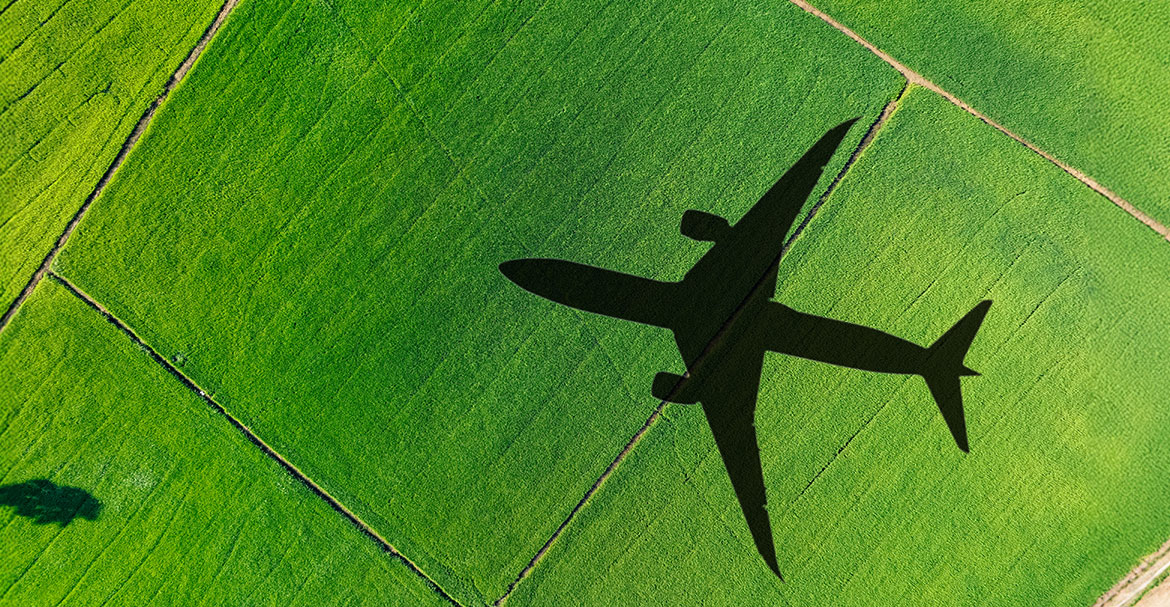
Flying sustainably
These processes are not only scientifically tested but also “ready for production” and are already commercially used by companies. In Sweden, for example, larger bioreactors are currently being built for precisely this type of fuel production. The method has the advantage of binding existing CO₂ so that the cyanobacteria can grow. This carbon dioxide can either come from the atmosphere or from combustion processes. Whether our fuel of the future will actually be emission-neutral also depends on the composition of the carbon supplied. Another, more biochemical challenge has so far existed in the efficient combination of isoprene with hydrogen so that the produced fuel meets aviation requirements. However, it should not take more than five or six years to find an economically viable solution that will allow the enormous amounts of fuel used by aircraft to be produced cost-effectively.
In order to make flying more sustainable, we need extremely large amounts of isoprene and hydrogen. The processes in the prototype laboratory tanks must therefore be scaled up from volumes in the low liter range to industrial standards. This is where biotechnology comes into play because we need to modify the metabolism of bacteria and algae so that they generate many times the substances we need. By using our computer models of these organisms, we can determine quite accurately which enzymatic adjustments need to be made without affecting other metabolic processes and potentially creating new problems. By focusing on proteins that we call “transcription factors” and that are upstream of the enzymes in the reaction chain, we gain control over a variety of downstream metabolic processes.
Our approach is not limited to the production of fuels but can also be applied to the production of other chemicals. This is because the optimization of enzymes in algae and bacterial strains or even plants for a specific end product can be transferred to any other industrial raw materials, whether for fuels, food, or cosmetic products. With the right enzymes, for example fatty acids, vitamins, starch, or sugar with any desired properties and composition could be produced. The meat of the salmon we eat gets its reddish color from the pigment astaxanthin, which is found in crabs and is added to fish feed in salmon farms. However, it is produced by algae, and a single gram costs manufacturers thousands of euros. It is not without reason that these organisms are also called cell factories.
This would make industry less dependent on the limitations of natural organisms. If I need an enzyme, I usually have to extract it from an existing life form, such as a plant. But why not design the enzyme myself and produce novel chemicals? Many researchers are working toward realizing this dream, and technically, it has long been possible. In the laboratory, enzymes can be optimized in terms of their performance in special environments through targeted selection pressure. A far more synthetic approach is to filter out specific enzymes from a catalog and modify the amino acids contained in them so that the optimized enzyme works in exactly the right way in a model organism.
Algae farms on the ocean
If I could, I would set up algae farms cultivated with these organisms on uninhabited stretches of coastline or on the ocean. That way, they would not compete with other interest groups (such as agriculture) for land, as would be the case with fuels from oil plants. However, industrial production is not so easy with living organisms. The density of the cultures, air supply, contamination – many factors must be monitored to ensure that everything runs smoothly. And it requires energy, which should ideally come from renewable sources. In fact, hydrogen obtained from algae could itself be marketed as a fuel and energy source wherever the infrastructure that is needed for liquid hydrogen is available. However, the product life cycle does not only include production. Before global aviation ultimately contributes less to global warming, the transport of this fuel to airports would also have to become emission-neutral.
Zoran Nikoloski has been Professor of Bioinformatics at the University of Potsdam since 2017. He is researching sustainable alternatives to fossil kerosine for the EU project “Alfafuels”.
Cyanobacteria are single-celled or multicellular organisms that are among the oldest life forms on Earth. Some photosynthesize and produce blue-green pigments, but they do not have a true cell nucleus and are not related to the actual green algae.
This text was published in the university magazine Portal - Zwei 2025 „Demokratie“. (in German)
Here You can find all articles in English at a glance: https://www.uni-potsdam.de/en/explore-the-up/up-to-date/university-magazine/portal-two-2025-democracy